Inverse problems
Variational reconstruction with sparsity-promoting and heavy-tailed priors. We combine total variation with a Cauchy prior to recover structure from limited, sparsely sampled PAT data.
PhD candidate in applied mathematics · 2024–2028
I build fast, large-scale reconstruction methods for 3D photoacoustic tomography — at the interface of inverse problems, computational imaging, and machine learning.
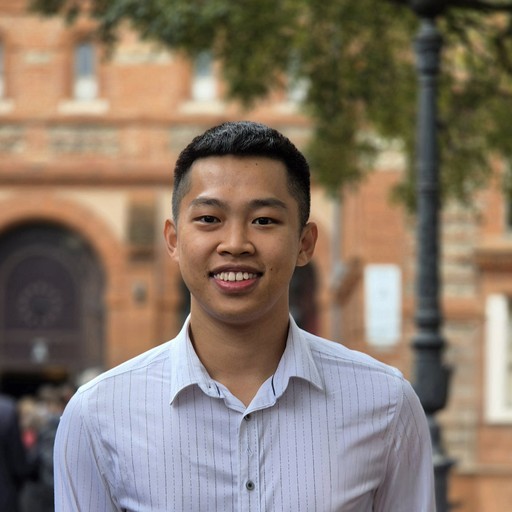
My thesis, Large-scale reconstruction methods for high-quality 3D photoacoustic imaging, supports the deployment of a new 3D photoacoustic tomography (PAT) scanner for biomedical studies. The difficulty is scale: a full 3D forward operator cannot be stored, so every reconstruction step has to be computed on the fly. Supervised by Paul Escande (CNRS, IMT), Caroline Chaux (CNRS, IPAL) and Hwee Kuan Lee (A*STAR, IPAL).
Variational reconstruction with sparsity-promoting and heavy-tailed priors. We combine total variation with a Cauchy prior to recover structure from limited, sparsely sampled PAT data.
The 3D forward operator is far too large to store. We use on-the-fly matrix–vector products so that advanced algorithms run on real scanner data within a realistic memory budget.
Modelling the electrical impulse response of the scanner, and approximating forward and adjoint operators accurately enough to reconstruct without paying the full physical cost.
With the A*STAR team, exploring deep-learning-based reconstruction for large-scale 3D PAT — and where learned components can safely replace or accelerate model-based steps.